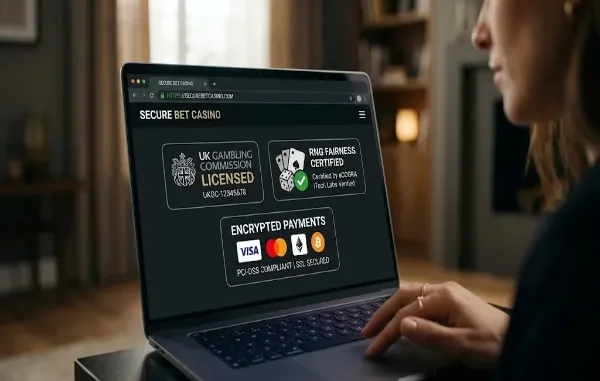
If you’ve ever tried to pick an online casino, you know the feeling: fifty tabs open, all of them claiming to be the “top-rated” or “most trusted” site of the year, all of them technically saying the same three or four things without actually telling you anything. Licensed. Certified. Secure. Trusted since whenever.
The problem isn’t a lack of information — it’s that most of it is marketing dressed up as reassurance. So let’s skip past the badges and banners and actually talk about what makes an online casino legitimately safe to use: who’s regulating it, whether the games are actually fair, and whether your money and personal information are protected the way they should be.

Start With the License — It’s Not Just a Formality
A gambling license sounds like paperwork, but it’s genuinely the single most important thing to check before you deposit a dollar anywhere. It’s the difference between a business that’s legally accountable to a regulator and one that can disappear with your balance overnight and face no consequences at all.
Not all licenses are created equal, though, and this is where a lot of casual research goes wrong. Some jurisdictions apply serious scrutiny to the operators they license. Others exist mainly to collect a fee and hand out a certificate.
A few licensing bodies are worth knowing by name because they represent meaningfully stricter oversight:
- The UK Gambling Commission (UKGC) is widely considered one of the toughest regulators in the world. It requires operators to segregate player funds from operating capital, enforces strict advertising and responsible gambling rules, and can and does revoke licenses.
- The Malta Gaming Authority (MGA) is one of the most common licenses for international online casinos, with a reasonably robust framework for player protection and dispute resolution.
- The Gibraltar Gambling Commission and a handful of others in Europe apply similarly serious standards.
On the other end of the spectrum, licenses from places like Curaçao have historically been criticized for lighter oversight and weaker enforcement, though the jurisdiction has been in the process of reforming its licensing structure. That doesn’t automatically make every Curaçao-licensed site untrustworthy, but it does mean the license alone carries less weight, and you’ll want to look harder at the other factors in this article before trusting the platform with your money.
The practical move here is simple: find the license number, usually sitting quietly in the footer of the site, and actually verify it on the regulator’s own website rather than trusting the casino’s word for it. A real license will show up in the regulator’s public database with the operator’s correct legal name. If it doesn’t show up, or the name doesn’t match, that’s not a technicality — that’s a reason to leave.
RNG Fairness: How Do You Know the Games Aren’t Rigged?
This is the part that understandably makes people nervous. Unlike a physical roulette wheel you can watch spin, an online slot or blackjack shuffle is happening inside software you can’t see into. So how does anyone actually know the outcomes are fair rather than quietly tilted in the house’s favor?
The short answer: independent testing labs.
Legitimate online casinos submit their random number generator (RNG) software to third-party laboratories that have no financial relationship with the casino or the game developer. These labs run enormous numbers of statistical tests against the RNG’s output, checking that results are genuinely unpredictable, evenly distributed, and consistent with the game’s advertised odds over time. If a game passes, it gets certified — and reputable operators will display that certification, along with the lab that issued it, rather than making a vague, unverifiable claim of their own.
A few names come up repeatedly in this space:
- eCOGRA (eCommerce Online Gaming Regulation and Assurance), based in the UK, is one of the oldest and most recognized testing bodies, known for its “Safe and Fair” certification and its focus on both RNG integrity and broader player protection standards.
- GLI (Gaming Laboratories International) is one of the largest independent testing organizations globally, working across a large number of gambling jurisdictions.
- iTech Labs, based in Australia, and BMM Testlabs are two more well-established labs that perform similar RNG and RTP verification work.
Beyond the certification itself, there are a couple of practical things worth understanding:
RTP (Return to Player) is the theoretical percentage of wagered money a game pays back to players over a very large number of spins or hands. A slot with a 96% RTP isn’t guaranteed to pay you back 96 cents on every dollar — it’s a long-run average, not a per-session promise — but a legitimate casino will publish this figure per game, and it should roughly match what independent testing has verified. If a site won’t tell you the RTP of the games it offers, that’s worth noticing.
Provably fair systems, common on crypto-friendly casinos, work a bit differently. Instead of relying purely on third-party certification, they let players cryptographically verify, after the fact, that a specific game outcome wasn’t altered — using a combination of a server seed, a client seed, and a hash that can be checked independently. It’s a genuinely useful added layer of transparency, though it’s a supplement to good regulation and testing, not a replacement for it.
The bottom line on fairness: don’t take “our games are certified fair” at face value. Look for the actual certifying lab’s name, and ideally verify that the casino appears on that lab’s list of certified operators.
Encrypted Payments: Where Your Money Actually Needs Protecting
Licensing and RNG fairness matter enormously, but they don’t do you much good if the site’s payment processing is a mess. This is where a lot of people’s actual financial risk lives — not in losing a hand of blackjack, but in a data breach or an unencrypted transaction.
A few things to actually check, rather than assume:
Basic transport encryption (TLS/SSL). This is the baseline, not a selling point — every legitimate financial site on the internet uses it. Look for “https://” and the padlock icon in your browser. If a gambling site doesn’t have this, stop right there; nothing else about it matters if this fails.
How payment data is actually handled. Reputable casinos don’t store your raw card number on their own servers — they route transactions through PCI-DSS compliant payment processors, the same security standard used by mainstream e-commerce and banking. If a site’s payment page feels janky, redirects you somewhere unfamiliar-looking, or asks for more information than a payment normally requires, treat that as a red flag rather than a quirk.
Segregated player funds. Under strong regulatory regimes like the UKGC’s, licensed casinos are required to keep player deposits in accounts separate from the company’s own operating funds. This matters more than it sounds — it’s the difference between your balance being genuinely yours and it effectively being an unsecured loan to the casino’s business operations if things go wrong financially.
Withdrawal behavior, not just deposit behavior. Plenty of shady operators make deposits frictionless and withdrawals a nightmare — sudden “verification” delays, unexplained limits, or support that goes quiet the moment you ask for your money back. A fast, easy deposit process tells you nothing on its own; a smooth, reasonably prompt withdrawal process tells you a lot more.
Payment method variety, cautiously. A wide range of payment options (cards, e-wallets, bank transfer, and increasingly crypto) isn’t inherently a red or green flag, but crypto deposits in particular are worth a second look: they’re often faster and can offer more privacy, but they also typically come with fewer consumer protections and chargeback options than a credit card transaction does if a dispute arises.
A Simple Way to Put This All Together
None of these three pillars — licensing, RNG fairness, and payment security — is a substitute for the other two. A well-licensed casino with a badly secured payment page is still a bad bet. A provably fair game on an unlicensed site doesn’t protect you if the operator simply refuses to pay out a big win.
Before depositing anywhere, it’s worth running through something like this:
- Find the license number and verify it directly on the regulator’s website, not just the casino’s own page.
- Check for a specific RNG certification from a named, independent lab, and confirm the casino appears on that lab’s certified list.
- Confirm HTTPS encryption and look for language about PCI-DSS compliant payment processing.
- Search for recent player complaints about withdrawal delays or disputes — a quick search of a casino’s name plus “withdrawal problem” tells you a lot in under a minute.
- Read the actual terms around bonuses and wagering requirements, since even a legitimate casino can bury unfavorable terms in fine print.
None of this takes more than about ten minutes once you know what to look for, and it’s ten minutes that separates an informed decision from a hopeful one.
A Final Word on Playing Responsibly
Security and fairness are one piece of the picture, but they’re not the whole picture. Even a fully licensed, provably fair, well-encrypted casino is still, at the end of the day, a business built on games where the odds favor the house over time. Checking for legitimacy protects you from fraud and theft — it doesn’t change the math of the games themselves. If gambling ever stops feeling like entertainment and starts feeling like something you can’t step away from, resources like the National Council on Problem Gambling helpline are there regardless of which platform you’ve been using.
Leave a Reply