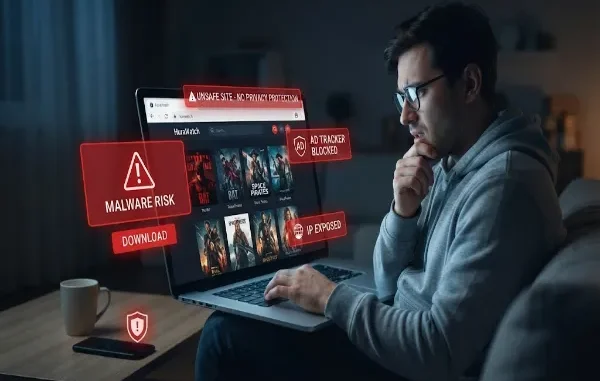
Is HuraWatch safe to use? Generally, no. HuraWatch and similar unofficial streaming sites can expose visitors to intrusive ads, malicious redirects, fake clone websites, malware, privacy concerns, and potential copyright issues. If you want to watch movies and TV shows online with less risk, licensed streaming platforms and legitimate free services are the safer choice.
You’re looking for something free to watch. A quick search leads you to HuraWatch. The library looks huge. Every movie you can think of seems to be there.
Before you click play, it’s worth slowing down for a minute.
Sites like HuraWatch look convenient on the surface. But there’s a lot going on underneath that isn’t obvious at first glance. This guide walks through what HuraWatch actually is, what the real risks are, and what a safer alternative looks like.
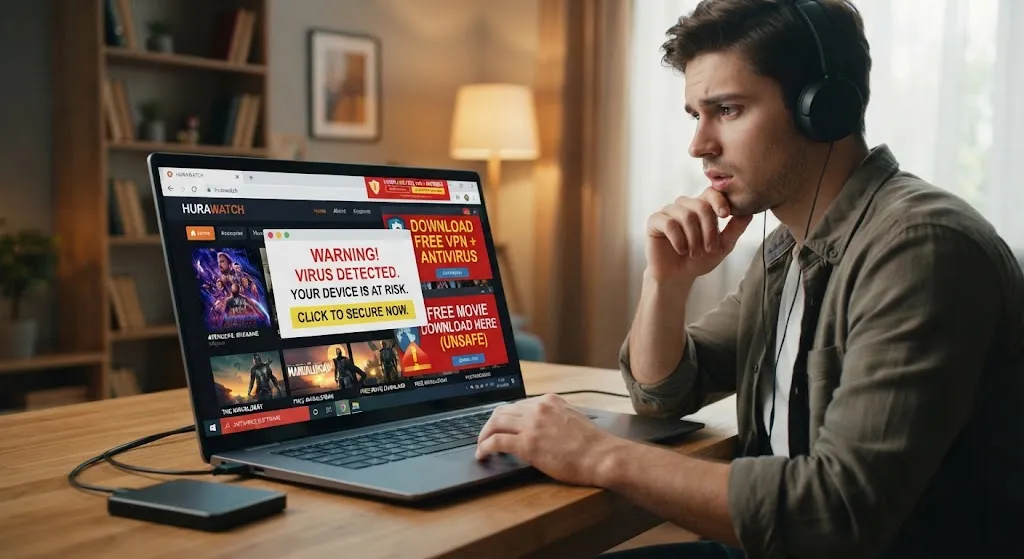
What Is HuraWatch?
HuraWatch is a free streaming website. It offers movies and TV shows without a subscription, without an account, and without any upfront cost.
That sounds great on paper. But there’s a catch. HuraWatch doesn’t host most of this content itself. Instead, it usually pulls from or redirects to third-party servers scattered across the internet. Nobody fully controls or vets what’s actually on the other end of those links.
That structure is part of why the site keeps changing domains. When one version gets taken down, another pops up somewhere else.
Is HuraWatch Legal?
Short answer: not really, in most places.
HuraWatch-branded streaming sites generally do not provide clear evidence that the movies and shows they offer are properly licensed for distribution. That’s the core problem. The people who made the content weren’t paid for it, and the platform doesn’t have permission to distribute it.
In practice, this means using HuraWatch involves accessing pirated content, even if the site itself doesn’t clearly say so. Laws vary depending on where you live. Some countries focus enforcement on the people uploading pirated content, not the people watching it. Others treat unauthorized streaming more seriously.
Either way, it sits in a legal gray zone at best. And that gray zone is exactly why the site keeps getting shut down and rebuilt under new names.
The Real Safety Risks
This is the part people underestimate the most.
Malware and infected downloads. Free streaming sites often rely on shady ad networks and third-party file sources. Some versions of HuraWatch or its clones offer app downloads, and unofficial APK files in particular carry a real risk of hidden malware.
Aggressive and unpredictable ads. Since the site doesn’t have normal advertiser relationships like licensed platforms do, ads can come from low-quality networks. Pop-ups, forced redirects, and fake “click here” buttons are common complaints.
Fake clone sites. Because HuraWatch operates through multiple domains, it’s genuinely hard to know which version is the “real” one at any given moment, if there’s even a meaningful difference. Clone sites can look identical while running completely different, and potentially more dangerous, ad code in the background.
Unlike established licensed streaming services, unofficial HuraWatch-branded sites may provide limited information about who operates the site, how user data is handled, and what accountability exists if something goes wrong. Licensed streaming platforms are required to meet certain privacy and security standards. Unofficial sites like HuraWatch have no such obligation, and no accountability if something goes wrong with your data.
Legal exposure. Even if enforcement against individual viewers is rare in your country, it isn’t zero. Copyright holders do pursue legal action in some cases, and the risk, however small, isn’t nonexistent.
Why It Feels Safer Than It Is
Part of what makes HuraWatch feel trustworthy is that it copies the look of real streaming platforms. Clean layout, familiar categories, a search bar, a “trending” section. It’s designed to feel like Netflix or Hulu.
But looking similar isn’t the same as being built the same way. Behind that familiar interface is a completely different set of infrastructure, ad partners, and accountability, or lack of it.
If You Still Decide to Use It
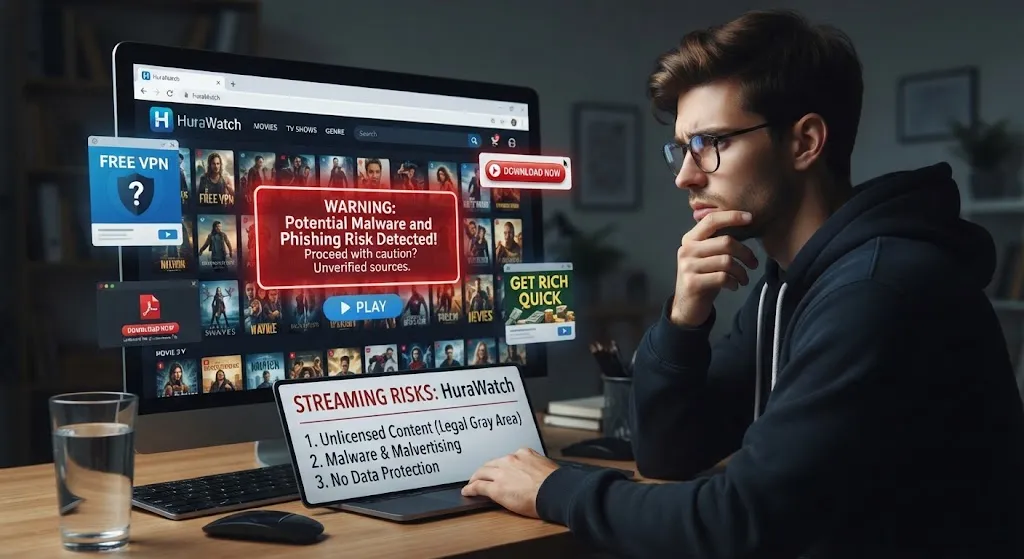
This isn’t a recommendation, just a realistic acknowledgment that some readers will use these kinds of sites regardless. If you do, a few precautions can reduce, though not eliminate, the risk:
- A VPN can improve privacy by reducing the visibility of your IP address to the websites you visit, but it does not make an unlicensed streaming service legal or protect you from malicious downloads, redirects, or phishing.
- Run updated antivirus software and let it scan any file before opening it.
- Use an ad blocker to reduce pop-ups and malicious redirects.
- Never enter personal information, payment details, or account credentials on the site.
- Avoid downloading any app or APK file from it entirely.
These steps lower your exposure. They don’t make the site legal, and they don’t guarantee safety. Think of them as damage control, not a fix.
Safer, Legal Alternatives
The good news is that free, legal streaming has genuinely improved in recent years. A few solid options:
Tubi — A fully licensed, ad-supported platform with a large and constantly updated library.
Pluto TV — Free live channels plus on-demand content, backed by a legitimate ad model.
Crackle — A long-running, studio-backed free streaming service with a rotating catalog.
Peacock (free tier) — NBC’s platform includes a meaningful amount of free content alongside its paid tiers.
None of these require sketchy downloads, unofficial mirrors, or constant domain-hopping. They’re supported by real advertising deals instead of the kind of ad networks that show up on unlicensed sites.
HuraWatch vs. Legal Streaming Services
| Factor | HuraWatch | Legal Streaming |
|---|---|---|
| Licensing | Often unclear | Licensed content |
| Cost | Usually free | Free or subscription |
| Ads | Can be unpredictable | Controlled advertising |
| Downloads | Potentially risky | Official apps |
| Customer support | Limited/unclear | Established support |
| Domain stability | Can change | Stable |
| Privacy information | Often limited | Published policies |
How to Recognize a Suspicious HuraWatch Clone
One of the biggest problems with unofficial streaming websites is knowing whether you have reached a legitimate-looking version or a copy designed primarily to generate advertising revenue or distribute malicious content. Be cautious if a page suddenly redirects you to another domain, repeatedly opens new tabs, displays fake virus warnings, or asks you to install a browser extension, media player, APK, or other software before you can watch a video. Misspelled domain names, excessive pop-ups, suspicious download buttons, and requests for personal or payment information are also warning signs.
A useful rule is simple: if a streaming page requires a download or asks for sensitive information just to play a movie, leave the page. A professional-looking design does not prove that a website is trustworthy. Clone sites can copy logos, colors, movie listings, and layouts almost perfectly, making visual appearance a poor way to determine whether a particular domain is safe.
What to Do If You Already Visited HuraWatch
If you have already visited HuraWatch, there is no need to panic. Simply opening a webpage does not automatically mean that your device has been infected or that your personal information has been stolen. However, if you clicked suspicious advertisements, downloaded a file, installed an application, entered a password, or granted unusual browser permissions, take a few precautionary steps. Close the website, delete any suspicious downloads, run a security scan with your updated antivirus software, and remove browser extensions or applications that you do not recognize.
If you entered a password on a suspicious page, change that password from the official website or app and avoid reusing it elsewhere. If you provided payment information, contact your bank or card provider and monitor the account for unusual activity. These steps cannot undo every possible risk, but acting quickly can reduce the potential damage and help protect your accounts and device.
The Bottom Line
HuraWatch offers what looks like a shortcut. Free access to almost anything, no subscription required. But that shortcut comes with real trade-offs: unclear legality, inconsistent safety, and zero accountability if something goes wrong.
Legal, ad-supported platforms have closed a lot of the gap that used to make sites like HuraWatch tempting. The content library might be slightly smaller, but the safety, reliability, and peace of mind are worth more than most people give them credit for.
Free doesn’t always mean free of cost. Sometimes the cost just shows up later, in a compromised device, a stolen password, or a legal notice you didn’t see coming.
FAQ
HuraWatch-branded streaming sites generally do not provide clear evidence that the movies and shows they offer are properly licensed for distribution. Copyright laws vary by country, so the legal consequences of accessing unauthorized content depend on where you live.
It depends on where you live. Some countries mainly go after people who upload pirated content, not viewers. Others take unauthorized streaming more seriously. The risk is usually low for individual viewers, but it isn’t zero.
Visiting a HuraWatch-branded site does not automatically mean your device has a virus, but malicious advertisements, redirects, and unofficial downloads can create genuine security risks. Unofficial APK downloads in particular are a common source of malware.
Because it operates in a legal gray zone, versions of the site get taken down regularly. New domains and clone sites pop up to replace them, which also makes it harder to know which version you’re actually on.
No. Unofficial streaming sites have no accountability for how your data is stored or used. Avoid entering any personal or payment information.
Legal, ad-supported platforms like Tubi, Pluto TV, Crackle, and Peacock’s free tier offer a real alternative. No sketchy downloads, no domain-hopping, and actual accountability behind them.
A VPN can hide your IP address and reduce some exposure, but it doesn’t make the site legal or eliminate malware risk from ads and downloads. It reduces risk. It doesn’t remove it.
Avoiding downloads reduces one important risk, but it does not eliminate the possibility of malicious advertisements, redirects, phishing pages, or unwanted notifications. The safest option is to use a legitimate streaming service.
It can expose your device to security risks, particularly through malicious advertisements, redirects, phishing pages, or unofficial downloads. Simply visiting a website does not automatically mean your device is infected, but you should avoid downloading unknown files or applications and keep your operating system and security software updated.
Sources
U.S. Copyright Office – Definitions and Copyright Basics
Federal Trade Commission – Malvertising Guidance
CISA – Protecting Against Malicious Code
Additional Source
Gridinsoft – Hurawatch.cc Security Scan and Trust Score
Editor’s Note: This is an independent, informational article. Hura-Watch.net is not affiliated with, endorsed by, or connected to HuraWatch or any streaming service mentioned in this article. We do not host, stream, link to, or distribute any movies, TV shows, or copyrighted content. This article is intended purely for informational and safety-awareness purposes, to help readers understand the risks associated with unofficial streaming sites before making their own decisions.
Leave a Reply